


In case you didn’t know, the Sabbath is now more popular than ever. Obedience to God’s instructions is picking up momentum, but at the same time, there are distinctly New Age deceptions creeping in that satan is using to disrupt things. This is a pattern that we’ve seen throughout the history of spiritual revivals, and this article will help you identify falsehood so that you can walk in a way that pleases God—in spirit and truth.
“But the hour is coming, and now is, when the true worshipers will worship the Father in spirit and truth; for the Father is seeking such to worship Him.” - John 4:23 NKJV
Over the past decade, the popularity and resurgence of the Sabbath has become very extraordinary. About eight months ago I was at a Goodwill thrift store where I picked up a few books that really caught my attention. With a pile of six books already in my hands, I reached out in a hurry, ironically, to grab just one more title. It was a bright red hardcover called The Ruthless Elimination of Hurry released in 2019. The author, John Mark Comer, is an evangelical Sunday-Christian pastor from Oregon with Calvary Chapel Bible College roots and a Western Seminary degree. Knowing nothing about him prior to picking up his book, I was stunned to see that one of the four core practices that he promotes is to observe the Sabbath day every week. When I saw that, I stood still for a good moment and wondered,
“Is a revival taking place right now?
How did I miss this book all these years?
What denomination does Comer belong to?”
I was even more surprised when I found out that this book has consistently ranked #1 on Amazon in the category of Christian Discipleship. It’s not just Comer, either. In recent years, numerous podcasts, YouTube channels, books, and conferences in the United States and abroad have all centered around one specific topic: what do we do with the Sabbath day?
About ten years ago, I experienced a major crossroads in my walk with God that led me to ask this exact question for myself. Being raised up in a nominal Christian household as a “gentile”, I finally made a firm commitment to Christ at the age of 16. But after eight solid years into my faith journey, things just didn’t add up. Going on missionary trips, attending a four-year Christian college, sitting through hundreds of church services, leading worship—no matter what I did, I just could not seem to satisfy that spiritual thirst within the essence of my being.
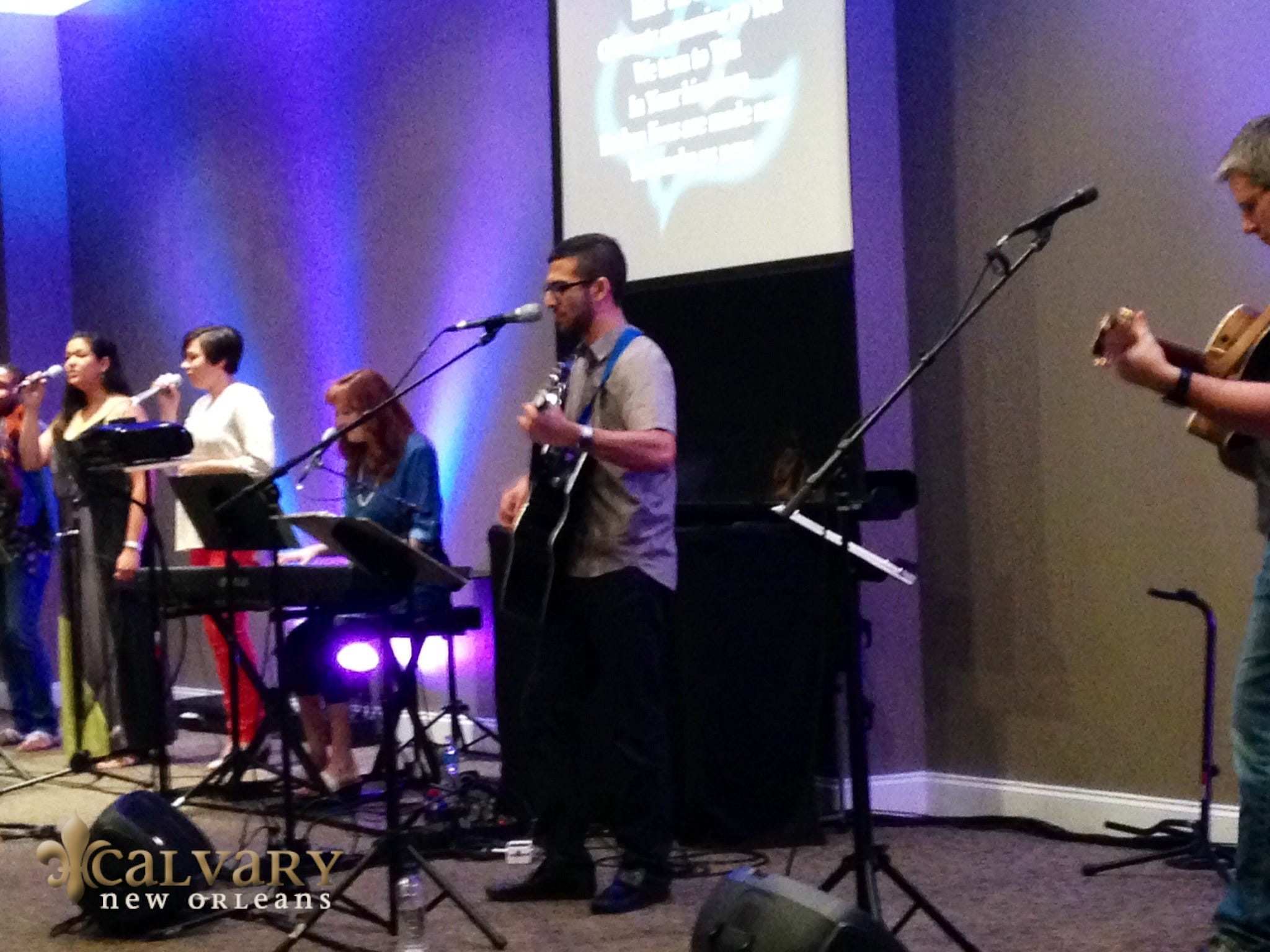
That’s me in 2014 with the worship team at Calvary New Orleans. This church used to meet at the Clearview City Center Mall in Metairie, Louisiana on Sunday mornings where the pastor rented a small venue that could seat over 100 people. It was a great group of people, and I even met my wife here. This church has since closed its doors.
I longed for the authentic Christian experience I always read about in the book of Acts. The early church’s miraculous accounts of holiness and supernatural intimacy with God were so real to me, yet so far away.
It didn’t matter where I looked for answers, either.
Pentecostal and charismatic churches weren’t the answer, just like the Calvary Chapel and Baptist churches I grew up attending. Something was missing, which is why I had no choice but to make the difficult decision to walk away from it all. Not only did I refuse to live a lie, but deep down, I knew whatever that one missing thing was, it was out there. I just needed to intentionally isolate from the cultural distractions and traditions that were preventing me from hearing God’s voice. Thankfully, my wife also wholeheartedly joined me in this investigation for the truth. Then, in 2016, my wife and I kept our very first Sabbath together as non-Jewish Christians.
That one simple act changed everything.
Walking in God’s ancient path, or The Way, comes from a place of deep conviction and true courage. It takes determination to step away from the comfort and familiarity of how we were all taught to follow God within the parameters of Western Christianity. All our lives, we were told:
“Keeping God’s Law is legalism. The Torah was nailed to the cross and done away with. That’s for Jews, anyways. You’re not supposed to keep the Law as a Gentile! The Law is actually a yoke of bondage. Even worse, you are trampling underfoot the blood of Christ by attempting to keep the ‘Old Covenant’. You have fallen from grace!”.
From Catholicism to Protestantism, this hostile consensus on God’s Law has been faithfully proclaimed for many centuries now. These sentiments towards God’s very own Word have been so pervasive and unanimous across virtually every denomination of Christianity that they were eventually accepted as normal. This strange animosity towards the first five books of the Bible originate from a specific heresy that sprung forth as early as the first century. More specifically, the reason why Christians are so convinced that obedience to God’s instructions is subjective and entirely optional has to do with a man named Marcion of Sinope,1 together with a few other early-church heretics. I invite you to investigate the topic of heresy by checking out a livestream I did a few months ago called 5 Ancient Christian Heresies STILL Haunting Us Today w/ Jeff Brannon”.2
Those all-too-common objections to observing God’s Law are merely symptoms rooted in the focus of our belief. We have misplaced the focus of our faith. The problem is that most of us have only looked to the words of Jesus for instruction, but we have utterly failed to let his actual lifestyle teach us how to live.
If for some reason you have not yet considered these things, then it’s time to rediscover authentic Christianity, exactly how Jesus Himself demonstrated it.
Not only is observing the weekly Sabbath day the fourth of the ten commandments, but this commandment predates the actual giving of the Law on Mount Sinai. This instruction was demonstrated by God during the very first week of creation (Gen. 2:2).
It’s no wonder, then, that the Sabbath was also an essential and core component of Jesus’ weekly routine during his earthly ministry. He was the Word made flesh, after all—the same Word present when the world was made (John 1:3). The Sabbath day allows for the perfect time (solitude) and space (silence) every single week to slow down and communicate with God while resting exactly as his instructions prescribe. Failure to do so is to go against the grain of the universe and the way it is fundamentally designed.
If you want to go against the grain, you will get splinters.
Anyone who sincerely wants to follow Christ must slow down and take the necessary time to define “The Way” that Jesus taught and practiced without letting 21st-century biases or seeker-friendly pandering corrupt the simplicity of the matter. This perspective is absolutely essential. It is also so easy to understand that even a small child can comprehend it. Jesus said:
“Abide in Me, and I in you. As the branch cannot bear fruit of itself, unless it abides in the vine, neither can you, unless you abide in Me.
… As the Father loved Me, I also have loved you; abide in My love.
If you keep My commandments, you will abide in My love, just as I have kept My Father’s commandments and abide in His love.” - John 15:4,9,10 [emphasis added]
It is as plain as day here. Just as Jesus kept the commandments, we must also keep the commandments of God so that we can abide in His love. These commandments are nothing new. They weren’t invented during the ministry of Christ, and the Apostles like Paul were not law-givers in charge of presenting new commands. On the contrary, the Law was simply reestablished, just as Paul said:
“Do we then make void the law through faith? Certainly not! On the contrary, we establish the law.” (Romans 3:31).
There was no brand new revelation in terms of righteous instructions for holy living in the New Testament. Even the “new” commandment of the Great Commission in Matthew 28:19,20 to go “teach” people “to observe all things that I have commanded” is a reiteration of God’s commandments from the Torah (Genesis to Deuteronomy). What many Christians are now realizing more than ever is that Jesus walked according to the Law, explained it, lived by example, and so should we—if we indeed want to be his disciples. John repeats this simple fact in no uncertain terms:
He who says, “I know Him,” and does not keep His commandments, is a liar, and the truth is not in him. - 1 John 2:4
Now he who keeps His commandments abides in Him, and He in him. And by this we know that He abides in us, by the Spirit whom He has given us. - 1 John 3:24
These verses should not be used to bash people over the head and make judgments about people’s eternal salvation.
Just because someone has been deceived into thinking that God’s commandments are “done away with” doesn’t mean that such a person isn’t born again or a true minister of God. Jesus told us there are those who will be “considered least” (Mat. 5:19). However, we should be skeptical about whether or not God is really speaking through someone when they go out of their way to adamantly and vehemently declare that “God’s law is a yoke of bondage and done away with.” Such attitudes are anti-Word, and they are actually in effect anti-Christ, which is why Jesus will say to many people, “Depart from me, you workers of lawlessness” (Matthew 7:23).
The problem is that we live in a day and age where the Word of God has been corrupted by tradition and divided into parts. One part is for Jews, people say, and the other part is for pagans. Jews have to do God’s Law. Pagans don’t.
Thankfully, we also live in the height of the information age, and people are starting to realize that they have been lied to about what it means to live a sanctified life, to live like Jesus did.
As John has stated, God’s Spirit is indeed working in our midst. Many people over the past decade have been discovering the beauty of obedience and adherence to God’s Sabbath day from Friday night to Saturday night like never before. People are also figuring out that the Torah is the ultimate foundation for the faith and practice of God’s people, just as it was for the first-century saints. Once this paradigm shift happens, the entire Bible opens up in a way that it is possible to walk in the newness of life that Paul talked about in Romans 6:4. It is also then possible to identify the very essence of heresy while expertly judging the degree to which ancient false teachings still manage to affect the Church to this day. This discernment is more important than ever because satan has been working overtime to pollute the pure water of the Gospel and Torah with the arsenic of New Age ideologies.
The truth is that every time there is an authentic revival back into following God and His instructions, there is also a counterfeit, or deception, that creeps in and disrupts the purity of the movement. Just go back to the book of Acts, and you’ll witness this clash between two worlds taking place. The Judaizers were one group corrupting the simplicity of being saved by grace alone and faith alone in the finished work of Christ (Acts 15:1). Simon the Sorcerer was looking to monetize his own brand of miracle-performing witchcraft, so he wanted to purchase the Holy Spirit’s power to make a name for himself (Acts 8:9). There are other examples of infiltration in the Scriptures, but let me give you three things that I have been witnessing since 2016—things that have crept in and corrupted the simplicity of what it means to follow Christ and keep His commandments. I think this will be eye-opening for you.
⚠️ 1. The Behavior Modification Trap
There is a certain demographic of people who have decided to start observing the Sabbath not necessarily because God commanded it, but because it’s trendy and edgy. The style is “in”, and they like the idea of being different and progressive in a success-obsessed culture of burnout. People who gravitate towards the Sabbath as a behavior modification tool tend to be big into lifestyle magazines, psychology, and Instagram culture, where motivational and inspirational imagery fuels forward progress and fosters positivity.
There’s nothing inherently wrong with being different.
There’s nothing wrong with being inspired to try new ideas.
There’s nothing wrong with questioning our culture’s concept of success.
But, true Christianity is not about reforming yourself or becoming a better person. When you say yes to Christ and become born again, you don’t actually experience a changed life—you instead experience an exchanged life. That’s why Paul said:
“I have been crucified with Christ; it is no longer I who live, but Christ lives in me; and the life which I now live in the flesh I live by faith in the Son of God, who loved me and gave Himself for me.” Galatians 2:20
True Christianity is about becoming born again, receiving God’s Spirit, and thereby becoming “one spirit with the Lord” (1Cor. 6:17). It’s not about trying to reform the old man that was crucified with Christ, it’s about being a new creation in Christ and living in God’s power and authority, especially supernaturally. That is why we can experience healing and deliverance in the name of Jesus!
Now, if you take the time to read John Mark Comer’s The Ruthless Elimination of Hurry, you’ll know what I’m talking about with behavior modification because he falls into this category. Let me be clear: I do recommend this particular book. I think there is a good amount of information to glean from it, and there are insights that will bless your life. But along the way, I carefully studied Comer’s motivation as to why he keeps the Sabbath. I also studied how he presents the Gospel at speaking events in churches. I paid careful attention to his language, his tone, his overall persona. One of the things I can tell you right away is that he avoids using the word sin when talking about the Bible’s core message and man’s need of a Savior for eternal redemption. He avoids the topic of hell. He also views His relationship with Jesus as an “apprenticeship”, which is interesting, and I like it. With that said, pay attention to what he says on page 173 of his book:
“There are all sorts of debate and controversy about whether we still have to keep the Sabbath as followers of Jesus. I’m in a minority that thinks we do. It’s one of the Ten Commandments, after all, and Jesus did absolutely nothing to annul it.”3 [emphasis added]
Comer does a great job saying that Jesus in no way shape or form destroyed His own commandment to keep the Sabbath. After all, He said that He is “the Lord of the Sabbath” (Mat. 12:8). Of course He did not nullify it! But then, Comer says this on that very same page, in the very same paragraph, in the very next lines:
“Yes, the early church moved it to Sunday, but up until the 1950s, Sunday was ‘the Lord’s day,’ and that meant a lot more than church for two hours; it meant an entire day of rest. But honestly? I wouldn’t really care if I don’t have to keep the Sabbath anymore. I want to keep the Sabbath. Even if the Sabbath is no longer a binding command, it’s still the grain of the universe. It’s a gift—and one I want to open and enjoy.”4 [emphasis added]
Do you see the contradiction?
First, Comer says that Jesus did absolutely nothing to abolish the Sabbath. Then, he contradicts this statement by strongly implying that the Sabbath is no longer a binding command. So which is it? Comer wants to have it both ways—a binding command and a non-binding command—because he is teaching that God’s Law is done away with.
He also maintains this seeker-friendly image throughout the rest of his work, to the point of compromise. In an attempt to appease the prevailing culture, Comer took liberty in quoting thought leaders from all sides of the spectrum, like Mother Teresa and Ghandi. He also quotes a non-Christian poet named Mary Oliver who he claims is a “life-long spiritual seeker”.5 I think in an effort to be relatable and communicate effectively, so many Christian thought leaders cave in to the pressure of selling out by pandering to what is deemed as popular in their prevailing culture. Such accommodations, or concessions, don’t need to be made. But then again, maybe that’s what makes a best-selling author just that? Comer is from Portland, Oregon, after all, and makes several references to progressive ideology in his work. Going back to the matter at hand, quoting secular and “spiritual” sources may seem harmless in isolation, but it actually does reveal where Comer spends a lot of his time getting inspiration. It reveals his desire to modify behavior, rather than to experience radical transformation through Christ alone.
This compromise was made even more clear to me through an interview he had with a guy named Jefferson Bethke. If you aren’t familiar with Bethke, he’s the one who posted a viral video on YouTube called “Jesus > Religion”. He eventually went on to write a book called To Hell with the Hustle that was released in 2019. It was also a book about keeping the Sabbath, and it was shockingly similar to Comer’s 2019 book.
Interesting, isn’t it?
Two books, two different authors, same year.
Both titles are about keeping the Sabbath.
Both titles have sold hundreds of thousands of copies. (Again, this is a rapidly growing movement.)
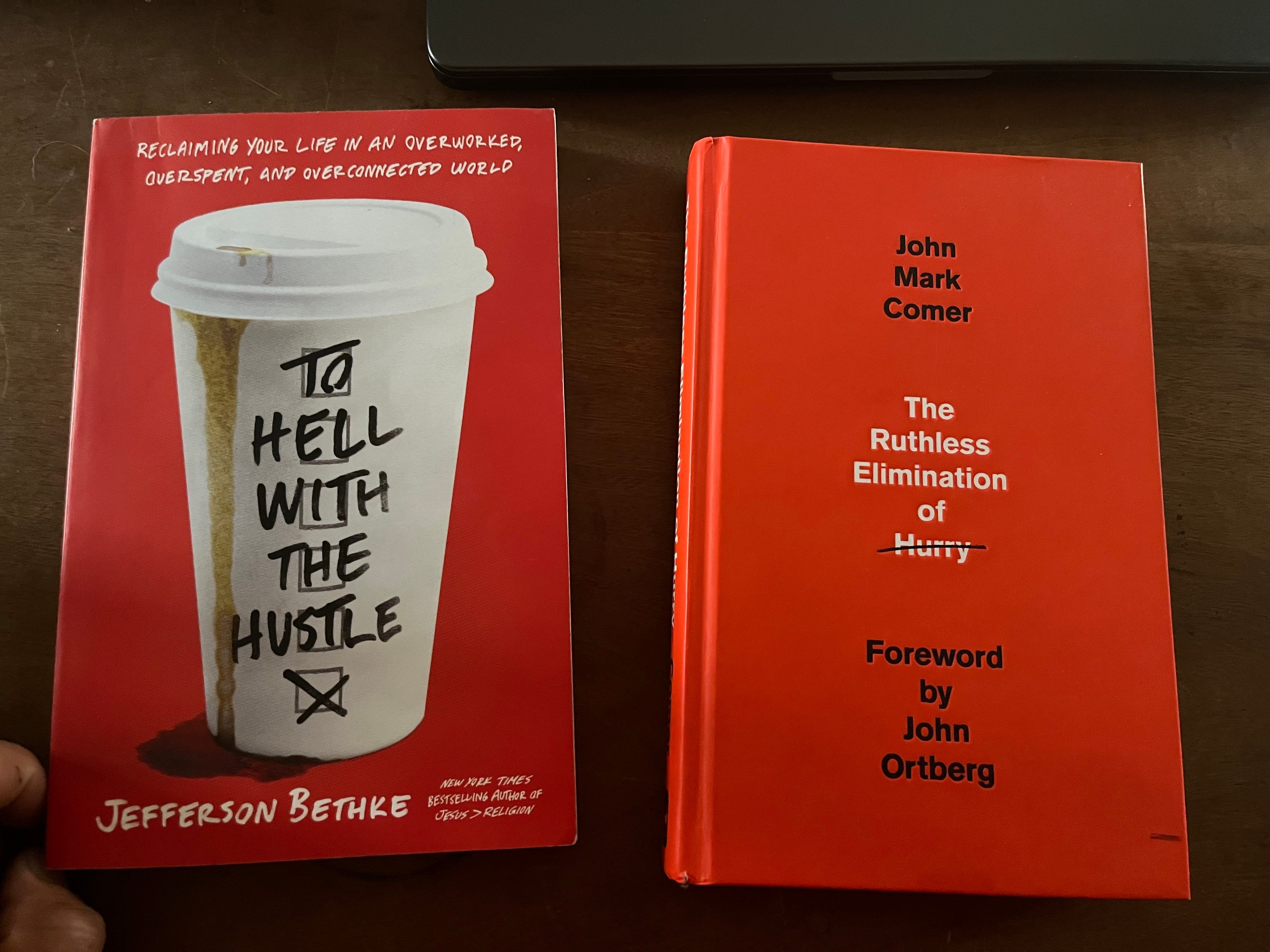
In my quest to understand different contemporary views on the Sabbath, I also ended up picking up a copy of Jefferson Bethke’s book, To Hell With the Hustle. Compared to Comer’s book, it has little to offer. I really only recommend Comer’s book if you’re looking for an interesting story of how he, as a Sunday megachurch pastor, made the switch to keeping Sabbath after experiencing worldly success but massive burnout.
Well, back on October 30, 2018, Bethke invited Comer to his podcast where they discussed “Our Addiction to Hurry”.6 It was quite an eye opener in terms of the mindset that these men are bringing to the Sabbath table—a mindset of behavior modification. As usual, they discussed different perspectives from a variety spiritual leaders. There was a strange undertone having to do with the Myers–Briggs Type Indicator, which is a personality test based on secular psychology.7 But then, what really opened my eyes to this hipster, progressive side of Sabbath-keeping was when these men wholeheartedly started talking about their Enneagram test results. If you aren’t aware, this personality test is a form of Eastern mysticism and can be traced back to the writings of “Evagrius Ponticus, a Christian mystic who lived in 4th-century Alexandria, Egypt.”8
Without getting into more of the details, just be aware that there is a growing culture of Sabbath observers who are doing it alongside of their other behavior modification tools. They want to be better humans. They want to be different from the culture. They want to adopt a mixture of spiritual teachings. Nevermind that there is some New Age and Eastern mysticism getting thrown into the mix. “Whatever makes me a better _____ (husband, father, leader, etc.) is good in my eyes.” Oh, and the Sabbath is a non-binding commandment, whatever that means. This is the mindset you’ll run into with this camp.
⚠️ 2. Attempting to Please God with Religious Performance
I would say that this is sort of the religious status quo in Sabbath-observing circles. Before it was trendy and hip, the Seventh Day Adventists (SDA) made the fourth commandment the integral and most important part of their religious organization. It’s in the name, after all. From the SDA, we have seen a lot of different offshoots and camps start their own organizations. One of the most wealthy and influential early on was Herbert W. Armstrong, but there have been several others. Due to the overwhelming number of Sabbath-observing camps around the world nowadays, people tend to automatically lump anyone wanting to follow God’s Law into the Hebrew Roots category. That is also where I found myself identifying for a time.
All of these churches and camps tend to have one major thing in common, and it is that they truly believe that they are winning God’s approval and blessings through their religious performance. It’s very easy to make this mistake. Just look at what the Torah says:
“If you diligently heed the voice of the LORD your God and do what is right in His sight, give ear to His commandments and keep all His statutes, I will put none of the diseases on you which I have brought on the Egyptians. For I am the LORD who heals you.” - Exodus 15:26
“The LORD will establish you as a holy people to Himself, just as He has sworn to you, if you keep the commandments of the LORD your God and walk in His ways.” - Deuteronomy 28:9 [emphasis added]
In isolation, it appears that God is giving His people an “If-Then” conditional commandment. It appears that if you do actually perform and work hard enough, then God will bless you. If you hustle and strive to earn God’s goodness, then and only then can you finally experience His amazing blessings.
But that’s the massive problem.
Absolutely nobody could ever perfectly keep the commandments of God. I don’t care who they are. Nobody has ever kept the Law perfectly. James said that “whoever shall keep the whole law, and yet stumble in one point, he is guilty of all” (James 2:10). He also said that “to him who knows to do good and does not do it, to him it is sin” (James 4:17). Nobody can meet God’s perfect standard in their own flesh and through their own performance. It’s simply impossible!
The blessings of health and prosperity in places like Exodus 15:26 and Deuteronomy 28:9 were never based on the performance of God’s people, because they always fell completely short of God’s standard. This concept is perfectly presented in Psalm 103:
He has not dealt with us according to our sins, Nor punished us according to our iniquities. - Psalm 103:10
The author of this particular Psalm was David, and he would know first-hand the meaning behind these words. He committed adultery with Bathsheba, and then he had her rightful husband Uriah murdered in an attempt to cover up his heinous sin after Bathsheba was found to be pregnant after David’s one-night stand. Of course God did not deal with David—or any of His people—according to their sins. If God dealt with us accordingly, we would all be dead! We cannot meet His standards.
So then, the purpose of the Law and the promises of the blessings were meant to point us toward a source that is outside of ourselves. The Law was meant to show us that we need mercy, that we need grace. Habakkuk 2:4 says, “Behold the proud, His soul is not upright in him; But the just shall live by his faith.” When it says that the just will live by faith, it is talking about placing your faith in a source outside of yourself. It is talking about having faith in God, not your own performance or perceived goodness. To put any hope, faith, or trust in your own religious performance is to be proud, and that person’s “soul is not upright in him.” Anyone trying to please God with their own works is under the same condemnation of the Pharisees, who through their phony religious traditions made the Word of God to no effect.
If we could earn God’s goodness based on our abilities, then Christ died for no reason. His death would be in vain! Of course, this is not the case. Christ died so that the curse of the law could be broken (Galatians 3:13), and now we can experience all of the blessings of Deuteronomy 28 because we have been born again! Christ has not redeemed us from observing His Law; He has redeemed us from the curse of the Law. That is why Paul said, “For Christ is the end of the law for righteousness to everyone who believes” (Romans 10:4). Christ is the end of the Law for the sake of achieving the righteousness that is required to experience the fullness of God’s blessings in this life, and the blessing of eternal life in the age to come. That’s what I call good news! Instead of miserably performing to somehow earn God’s favor, we should rest in what Christ has already done.
The difference between Old Testament saints and the saints after the pouring out of the Holy Spirit in Acts 2 is the level of revelation that each group received. The Old Testament saints like Noah, Daniel, and Job who were considered righteous only had a partial revelation about God’s goodness, favor, and grace. They looked to God and not their own performance, but they didn’t yet have the full knowledge of Christ’s redemptive work. The saints from Acts 2 onward, including you and me, have the full revelation of God’s Word, His grace, and His power in our lives. That is why Jesus said, “Assuredly, I say to you, among those born of women there has not risen one greater than John the Baptist; but he who is least in the kingdom of heaven is greater than he” (Mat 11:11). We are even greater than John the Baptist because we have the full revelation of Christ that he never had.
Those who are trying to earn God’s goodness are doing so completely in vain. Again, this includes your Seventh Day Adventists and overwhelming majority of Whole-Bible, Return-to-Torah, and Hebrew Roots circles. Paul says it perfectly:
For they being ignorant of God’s righteousness, and seeking to establish their own righteousness, have not submitted to the righteousness of God. (Romans 10:3)
If you find yourself in this camp, it’s time to learn how to rest in the finished work of Christ and thereby experience the righteousness of God.
⚠️ 3. Bitterness that Leads to Distrust of All Christian Fundamentals
You probably know at least one person who falls into this camp. They spend 20-40 hours a week online, researching the latest conspiracy theories about religion. They realize that the Torah is not done away with, but they then get very suspicious about everyone’s motives.
They question all of church history.
They question the very fundamentals of the faith—the trinity, the canon of Scripture, the correct way to keep track of time—they throw anything orthodox out of the window while automatically giving greater weight to things that are hidden, unknown, and mysterious.
They get obsessed over how to pronounce the name of God.
Is it Yahuah, Yahveh, Yehovah, Yahweh? Is there a conspiracy by the kabbalists to make us start using the name “Yeshua”?
Does the name of “Jesus” mean “Baal”? Are we calling upon the name of a false God?!?
OH NO!
There are so many different manifestations of this type of behavior, but I’m sure you know exactly what I’m talking about. It all stems from a root of bitterness.
Like I mentioned, one of the things that gets heavily attacked is the Bible itself. People start saying that our Bibles are incomplete and that we need books like Jasher, Jubilees, or Enoch in order to walk righteously in the full counsel of God. In fact, this attitude has become so pervasive that I dedicated eight months to researching the truth about the book of 1 Enoch that no one else was willing to talk about, including its roots in the occult, mystery schools, and Eastern mysticism. It’s a New Age document, in other words, and it is one that is revered in the writings of modern Freemasonry.
For my full analysis, make sure to watch this video here:
The bottom line is that people feel betrayed by mainstream Christianity and religion, so they go about things with a bitter attitude that constantly looks for opportunities to belittle and correct others.
Look, I get it.
Getting lied to about something so fundamental like God’s Law is a big deal. It can incite feelings of betrayal. It can arouse suspicion.
But there is so much good within the world of mainstream Christianity. There are many doctrines and teachings that fall into agreement with God’s Law. There are many Christian ministries, authors, and speakers to glean information from. In fact, my wife is currently attending New Orleans Baptist Theological Seminary where she is earning her MDiv. in Women’s Ministry. I have attended a four-year Christian college in the past, and I am currently taking a Bible college course myself from a different institution.
There is a reason why the biblical canon is the way that it is. There is a reason why Jesus is a perfectly valid name, just like Jesús in Spanish or other names. There is a reason why certain fundamentals of Christianity have remained intact for the past 2,000 years and why God used it to spread His message all over the world.
It’s time to take heed to the words of Peter when he said this to Simon the sorcerer:
“For I see that you are poisoned by bitterness and bound by iniquity.” (Acts 8:23)
Bitterness and anger will consume a person to the point where they become bound, or enslaved, by these emotions. It is the exact opposite of the life that Christ wants His followers to live. We are meant to live an abundant life of health, deliverance, and prosperity.
If you find yourself with even the slightest amount of bitterness toward any pastor or any ministry in the past that has hurt you whatsoever, and you haven’t confessed and surrendered those things at the feet of Christ, then the opportunity to do so is right now. For as Peter also said to Simon the sorcerer:
“Repent therefore of this your wickedness, and pray God if perhaps the thought of your heart may be forgiven you.” (Acts 8:22)
Don’t keep Sabbath from a place of religious pride and bitterness like many in the Hebrew Roots community often do. Keep it from a place of true rest. Keep it from a place of overwhelming love for Christ and deep appreciation for His redemptive work in your life.
Final Thoughts:
What are some of the top takeaways you got from this article? Have you found yourself in any of the three camps: Behavior Modification, Performance, Bitterness? I had found myself in the final two categories at different times in my walk with Christ, but by His grace, I have been completely set free. Let me know your thoughts down in the comments below. And, if you know someone that needs to read this article, please take a quick moment to send it to them. This could be their moment of breakthrough!
Your brother in this fight,
Abraham Ojeda
Sources:
Wikipedia contributors, "Marcion of Sinope," Wikipedia, The Free Encyclopedia, https://en.wikipedia.org/w/index.php?title=Marcion_of_Sinope&oldid=1356266161
Abraham - Overcome Babylon, “5 Ancient Christian Heresies STILL Haunting Us Today w/ Jeff Brannon”, Dec 11, 2025, https://www.youtube.com/watch?v=Pz7mpN1TrtU
John Mark Comer, The Ruthless Elimination of Hurry, (Colorado Springs, CO: WaterBrook, 2019) page 173.
Ibid.
Ibid, 53.
Jeff and Alyssa, “Our Addiction To Hurry | John Mark Comer Interview,” October 30, 2018, https://www.youtube.com/watch?v=XQUfog4EGuk
Wikipedia contributors, "Myers–Briggs Type Indicator," Wikipedia, The Free Encyclopedia, https://en.wikipedia.org/w/index.php?title=Myers%E2%80%93Briggs_Type_Indicator&oldid=1363980933
Ibid, https://en.wikipedia.org/wiki/Enneagram_of_Personality
Someone left a comment on a YouTube post I made for this article, and I want to share it with you. I think it will be helpful concerning how to actually observe Sabbath:
Question from @AStillSmallVoice1912:
This was a great article. I would like you to add commentary regarding Mark 2:27-28, as well as what you do on the Sabbath day - not the specific foods you eat, but actually what you do.
Jews believe they can only travel a certain distance, yet Jesus was “passing through the grain fields” indicating He went beyond their accustomed boundaries.
So what does a Sabbath rest look like as a Christian in 2026?
My Response:
Great question and thoughts. I keep things very simple. I don't start acting Jewish and go light candles and recite a bunch of liturgical prayers, like a lot of Hebrew Roots types like to do. However, Sabbath is more than just a "day off", which oftentimes is used for shopping, chores, and catching up on missed tasks. That's not Sabbath at all. Sabbath incorporates rest and worship together. But there is great liberality and flexibility with what that looks like for everyone individually. It could be a long walk in nature that helps you get closer to God (hence Jesus in the grain fields). For guys like me with heavy labor in my normal work schedule, it's taking time to turn off all tech and do very little. I just take care of my flocks and spend most of the time reading things that bless my walk with God. Prayer is important too of course. For families, teaching the kids things about God is going to be important, so that would include prayer routines and Friday-night meal routines that usher in the Sabbath more intentionally. Hope that helps!
thank you so much my friend. matt in NZ