


Grace and peace to you.
If you are new to my work or haven’t heard my full story, I want to take a moment to re-introduce myself and how I first got into survival and preparedness.
My name is Abraham Ojeda.
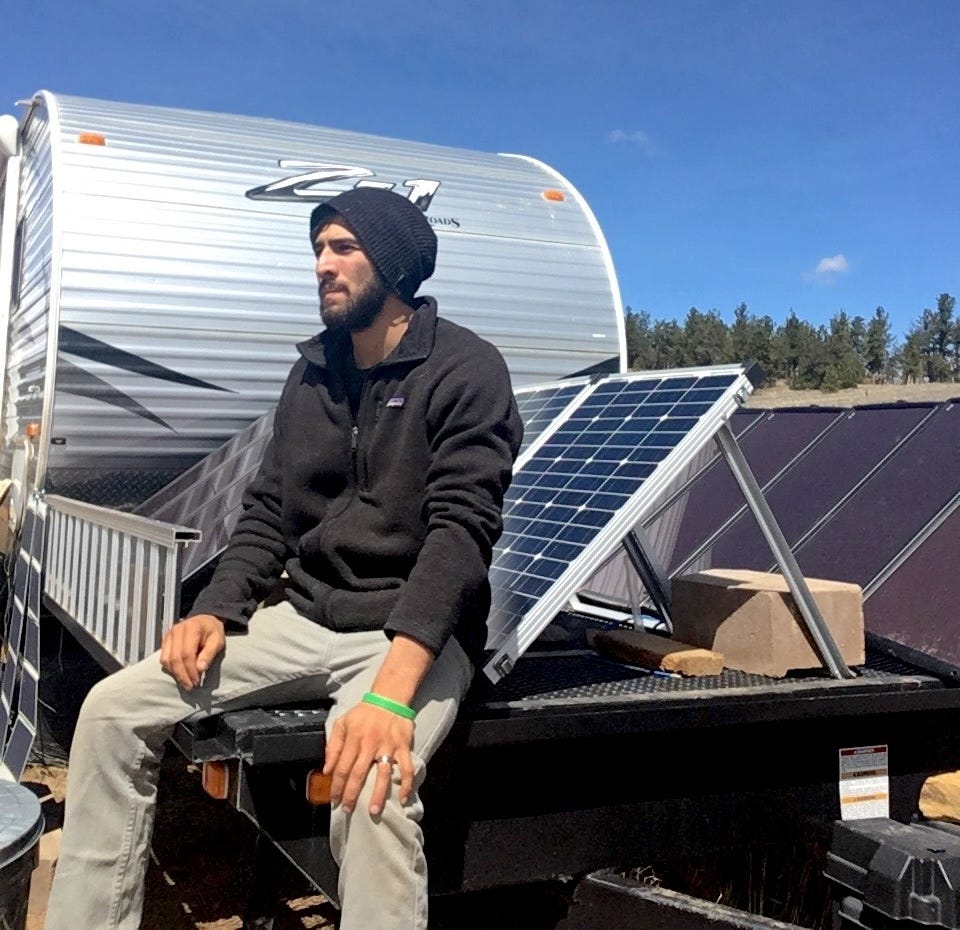
Since 2018, I have been living off grid with the purpose of getting prepared for the chaotic future while also embracing the same agrarian lifestyle we see in the Bible from Genesis to Revelation. After spending four years earning my first degree in Natural Sciences, I entered the professional world first as a teacher and then as a chemist. However, being a lifelong student of Bible prophecy led me along an interesting and unusual journey that involved pursuing a second four-year degree in Horticulture, or the art and science of growing plants.
One day in 2014, I experienced a God-given spark—an idea—of living off of the land that aroused intense feelings of satisfaction and purpose. This awakening also coincided with my 2013 investigation into the truth behind September 11, 2001. I knew something was deeply wrong. I began asking questions and searching for the truth, no matter where it led.
Food security quickly became very important to me.

All my life I had been going to the grocery store and relying on a supply chain to keep me fed and nourished. I was disconnected from the essence of food while accepting things like GMOs, petroleum-derived food additives, and chemical agriculture as normal. But, God awakened my soul to the dangers of it all. Through podcasts, books, events, and even personal health battles, I began having a massive paradigm shift that ultimately led to making drastic decisions. I didn’t understand it all at first, but each prayerful decision led me closer to God’s will and into a lifestyle aligned with the core principles of the Bible.
That’s when my wife and I took the plunge and left Denver in the rearview mirror, where it belonged.
Leaving the city life in 2018 to build our homestead at 9,000 ft elevation in the Rocky Mountains wasn’t easy. It was a decision fueled by an unquenchable desire to attain food freedom and economic independence. The nine-to-five grind wasn’t cutting it, and no matter how much money my wife and I set aside from each paycheck, the future seemed bleak. Something needed to change. So, there was nothing left to do but downsize, live in an RV, throw some solar panels on it, and camp on a few acres that we purchased while simultaneously building our house from the foundation up. I still remember the feeling of not having to hand over thousands of hard-earned dollars to the landlord for monthly rent. It was bliss. Of course, that initial feeling of freedom did come at a price.
The reality is that many people don’t make it to the end of a custom home building project. They run out of money. They get scammed by a homebuilder (this happened to us in 2016). They get tired, burned out. Many couples even end in divorce.
Faith in God and not losing sight of His divine inspiration proved to be the solid foundation that could not be shaken, even in the face of extreme adversity.
That God-given spark of life kept me and my wife going through some of the hardest times in our life. Dry camping, shivering in the face of -47°F (-43°C) winter nights, using a 5-gallon bucket for a toilet, not showering for a week or more at a time—these were all necessary strategies for surviving. Not surviving a crisis, per se. But surviving the skyrocketing housing prices, Federal Reserve monetary policies designed to impoverish the middle class, and sophisticated systems of corporate enslavement that keep the average household shackled to endless cycles of debt and interest payments.
Then the year 2020 happened.
Suddenly, all of the training, hardship, and lessons learned throughout my life were starting to make more sense. Whether it was strategic relocation, horticulture, raising chickens, or preserving food, all of the things I had learned started becoming mainstream after Covid-19 and the lockdowns. New prepping channels on YouTube along with books, courses, and products have since flooded the preparedness marketplace looking to cash in on people’s desire to become more self-sufficient in an increasingly unstable world. Sadly, a good portion of the information out there is coming from inexperienced people that don’t really know what they’re talking about. That’s why I am taking a little more effort to talk about these things here on Overcome Babylon moving forward.
A little over a century ago, many of the principles I am going to share with you were a casual part of everyday life. The rapid urbanization of the West after the industrial revolution has now created a wedge between natural survival instincts and the new normal of high-tech convenience.
With that said, it’s time to take a step back, slow down, and assess the concepts of survival and preparedness from a biblical standpoint that goes well beyond the materialistic accumulation of “survival products” and things. It’s time to embrace a more balanced approach that is both minimalistic yet practical. It’s time to understand preparation as a spiritual discipline, akin to prayer and solitude.
It’s time to return to God’s design.
Is “Preparedness” Faithless and Sinful?
Having been a Christian for almost two decades now, I have received my fair share of pushback and accusations from religious people whenever I bring up this topic. There is a lot of unnecessary controversy surrounding survival and preparedness, and it’s imperative to navigate these things with wisdom, especially in light of the Iran and Israel War that just restarted on February 28, 2026. Let’s first take a moment to define it. Here’s my definition:
Preparedness is the act of acquiring and using assets that act as a hedge to increase resilience and survivability in both short and long-term disaster scenarios.
Any sensible person can look at that definition and find it not only agreeable but a necessary part of life. Assets can be understood as both material items like water storage tanks and also non-material things such as knowledge, skill, and wisdom.
In fact, nearly every person has adopted at least some form of preparedness in their everyday life without fully internalizing it. That spare tire in the car, set of jumper cables in the trunk, first aid kit in the closet—everyone has items that might act as a hedge in the event of an accident. The problem is that most people don’t methodically consider major disasters and then take proper inventory to face these scenarios with a actionable plan in place.
Feeling overwhelmed and helpless, people’s attitudes tend to quickly turn from reasonable and calm to vicious and accusatory when faced with the reality that they need a real plan. People like me are often in the crosshairs of verbal attacks and slurs as others’ insecurity and fear are outwardly projected. Within the Christian community, it is sadly prevalent for people to also retaliate with spiritual abuse while acting as if God is backing every word they utter.
Christians tend to believe that if you prepare for doomsday, you are a faithless, cowardly, and fearful person that is not trusting in God’s goodness and provision.
I want to address these things because it is a gross misunderstanding of the foundational message of the Bible and is often based on cherry-picked lines from Jesus’ moral teachings within the Sermon on the Mount. People also like to use certain lines from Paul to take a non-preparedness approach to the future. In fact, I received a comment (see below) like this just recently:

The accusation here is that I (along with anyone who has incorporated preparedness into their everyday life) am operating from a place of “fear programming from subconscious trauma…”.
Like I said, religious people can get quite vicious.
The Bible itself, on the other hand, regularly and openly condemns a passive, complacent, and simple-minded attitude towards preparedness. There are a multitude of examples, but below are a few of my favorite verses. I will categorize them according to our modern day “preparedness” vernacular:
Strategic Relocation
A prudent man foresees evil and hides himself, But the simple pass on and are punished. - Proverbs 22:3
Thus says the LORD: “The people who survived the sword found grace in the wilderness” - Jeremiah 31:2
“Those who survive will escape and be on the mountains like doves of the valleys” - Ezekiel 7:16
Staple Gardening
Go to the ant, you sluggard! Consider her ways and be wise, Which, having no captain, Overseer or ruler, Provides her supplies in the summer, And gathers her food in the harvest. - Proverbs 6:6-8 NKJV
He who gathers in summer is a wise son; He who sleeps in harvest is a son who causes shame. - Proverbs 10:5
Prepare your outside work, Make it fit for yourself in the field; And afterward build your house. - Proverbs 24:27
Homestead Resilience (Reducing Supply Chain Dependence)
“…aspire to lead a quiet life, to mind your own business, and to work with your own hands, as we commanded you” - 1Thessalonians 4:11
But if anyone does not provide for his own, and especially for those of his household, he has denied the faith and is worse than an unbeliever. - 1Timothy 5:8
And sow fields and plant vineyards, That they may yield a fruitful harvest. - Psalm 107:37
Bug-Out Bag and Self Defense
And He said to them, “When I sent you without money bag, knapsack, and sandals, did you lack anything?” So they said, “Nothing.” Then He said to them, “But now, he who has a money bag, let him take it, and likewise a knapsack; and he who has no sword, let him sell his garment and buy one. - Luke 22:35,36
These are just ten passages that speak of an agrarian life that is centered around the essentials of preparedness and survivability. There are many more. As you can see, there is a strong emphasis on having productive fields that produce the necessary food for your household. In fact, crop production is so important that Proverbs 24:7 says that you must prepare your fields first before even building your house. This is the same approach that I took when I built my homestead. I was already rotating sheep and cultivating raised beds before my house even had the drywall or plumbing installed.
That being the case, I want to address some of the very common misconceptions I have gotten over the many years now. These are things you might even have on your own mind. Christian culture as a whole has embraced a collectivist mentality that tends to regularly shuffle around these three core objections I will now address. Keep in mind that just because these arguments are very popular doesn’t mean they are inherently true. They are unbiblical, as you will find out.
Argument #1: “The Bible is Against Self Defense”
The idea is that because the Bible is against self defense, therefore you shouldn’t worry about preparedness and survival. Someone is just going to show up to your house, steal your preparations, and kill you, anyways, and you’re not allowed to do anything about it.
It’s time for major pushback against this baseless claim.
One of the verses I quoted in my list above is from the words of Jesus in Luke 22:35,36. This Scripture is of utmost importance when it comes to preparedness. In the context of the passage, Jesus is telling his disciples how they are to live after Jesus ascends to heaven. He says that although they did not have to carry extra belongings when He was physically present with them, they now have to exercise a sense of survival and preparedness in his absence. He tells them to have a bag (for money, like a wallet), a knapsack (a leathern sack, in which travelers and shepherds carried their provisions1), and a sword. In other words, Jesus told His disciples to get their bug-out, or travel bags, ready for the missionary work ahead of them. These provisions were not necessary when Christ was with them because we saw how Jesus would miraculously provide time and again in the presence of His disciples. Once He ascended to heaven, however, the instructions for daily life were simply different.
What most people completely miss in their reading of these verses from Luke is the fact that Jesus commanded the disciples to have a sword, to which they replied that they had two on hand. Christians fail to realize that Jesus’ instructions nearly trespassed Roman law at that time in history. Because the Jews were living under Roman rule at that time, they were also subject to the laws and ordinances of the Roman Empire. This was also a time when Jewish groups like the Zealots were actively opposing Roman rule and even instigating violence. The history of the Jewish people was also full of examples of insurrection and revolt against foreign governing bodies. Knowing this, the Romans restricted the Jews from owning military-grade swords, which were deemed to be anything around 24 inches or longer.2 Though the law did allow for the use of blades such as the Machaira—a short, curved blade 18-20 inches long—openly carrying these blades would automatically come under the watchful eye of the Romans. Knowing this, Jesus still instructed his closest followers to have a sidearm for self-protection, survival, and agricultural tasks. He wasn’t afraid of what the Romans thought. He didn’t go the “extra mile” in an attempt to appease the Roman rulers.
Modern Christianity likes to overemphasize Jesus’ teachings to “turn the other cheek” and “let someone sue you and take your cloak”, but there is often little to no consideration of the context. Such statements from Jesus’ Sermon on the Mount must be balanced in light of the Torah and His clear instructions within the Gospels themselves. 1 John 3:4 plainly states, “Whoever commits sin also commits lawlessness, and sin is lawlessness.” Sin is breaking the Law of God, and therefore because Jesus lived a sinless and perfect life, He adhered perfectly to the Torah. This also means that He could not break Torah by adding to it or taking away from it as stated in Deuteronomy 12:32. Jesus upheld the Torah and practiced it, and so we must walk in His footsteps.
While we should maintain a humble heart of love and peace, there is a clear instruction throughout the Bible to defend one’s honor and die with dignity, as the Holy Spirit leads.
Being a martyr doesn’t mean abandoning basic human rights, and one of those rights that is clearly affirmed from the Torah to the Gospel is the right to self defense.
Argument #2: “God Will Miraculously Provide for Me, So I Don’t Have to Prepare”
Whether it is Seventh Day Adventists or Protestant Sunday Christians, I have heard this argument from numerous religious camps. To justify this position, people often point to Elijah being fed by ravens in the wilderness or Israel’s wanderings in the wilderness where they received manna. Both these examples and others like them are extreme outliers on the timeline of history. They are extremely rare events. There was only ever one Elijah in the Bible, and the conditions of the manna provision in the wilderness were also equally unique and unprecedented. Instead of overemphasizing these unique sort of miracles and apply them pretentiously to oneself, it is important to take the words of Christ at face value and then let that formulate your standard operating procedures as a disciple. Listen to what He said:
“These things I have spoken to you, that in Me you may have peace. In the world you will have tribulation; but be of good cheer, I have overcome the world.” - John 16:33
Jesus affirms that the believer will have tribulation in the world. That being the case, why not prepare for it, especially in light of the multitudes of Scriptures that affirm the need to be a good steward? Moreover, Paul tells us that we must be ready and willing to suffer for the sake of Christ:
“For to you it has been granted on behalf of Christ, not only to believe in Him, but also to suffer for His sake” - Philippians 1:29
Western Christianity does not want to wake up and smell the coffee, so to speak. All that is needed is a careful look at Christian communities worldwide to see these two verses in action right before our eyes. From Africa to the Middle East and Asia, there is persecution happening right now, usually from radical Muslim extremists. Just look and see how God is working in the midst of the persecuted church, and you will understand why this second argument is so incredibly flawed.
One such church is in Gaza.
The reality is that the Christians in Gaza did not receive miraculous provision from heaven in their hour of greatest need. They lived through the words of Philippians 1:29 and suffered for the sake of Christ as they watched their neighborhoods and homes turned into dust and ashes by the IDF’s relentless bombing campaigns that commenced on October 2023. There were no ravens feeding them. There was no manna. Instead, as explained during one of my recent interviews, men like Pastor Hanna Massad provided more than 60,000 hot meals to his fellow Gazans as a result of his wise stewardship and provision. This is precisely the kind of example that Christ wants his people to showcase to the world. It is an excellent witness of Christ’s teachings.
If you have not yet seen my interview with Hanna, I encourage you to go watch it now:
Argument #3: “Your Spiritual Life Will Suffer Without a Church Community”
One of the greatest systemic illnesses within the Christian community is something that I like to call Christian collectivism. It is the idea that without a church family, regular church attendance, or some sort of Christian community atmosphere, any believer’s faith will slowly wither and die. Because of this, they say, Christians don’t have to worry about relocating away from major cities, suburban areas, and disaster zones because it would be inherently sinful to leave the “church family” behind.
Multiple verses and passages are used to justify these claims, particularly Hebrews 10:25, which states,
“not forsaking the assembling of ourselves together, as is the manner of some, but exhorting one another, and so much the more as you see the Day approaching.”
The truth about this particular verse (and others like it) is that it is very easy for the pulpits to push this narrative because it is in their own self interest to do so. The more people attend the churches, the more money the pastors make. There is a blatant conflict of interest when pastors start mouthing off Hebrews 10:25 to harass the sheep because they are heavily motivated by the almighty tithe into their coffers.
The truth is that Hebrews 11 (the very next chapter) talks about the Great Hall of Faith, as it is often called. If you notice the pattern of the men and women spoken of in Hebrews 11, they tend to have one thing in common. They didn’t regularly attend churches or have community; yet their faith didn’t die. It grew far stronger than most ever have or ever will.
In the solitude of the wilderness, Abraham walked with God.
After exercising his right to self defense, Moses left his “church” community behind in Egypt to live in the wilderness, where he became one of the greatest men of faith in history.
David is also mentioned—a man who became the “man after God’s heart” as a result of his intense life of survival in the wilderness.
There are many more examples, and that is why Christian collectivism is a false doctrine at this point in history. Yes, theoretically, if there were a strong Christian community that operated in both Spirit and Truth, then it would be a worthwhile group of people to fellowship with. However, as has already been alluded to, Christian culture as a whole has become so disconnected from basic biblical concepts that it is no longer worth joining with for the most part. The vast and overwhelming majority of Christians are doing nothing to prepare for what’s about to overtake the earth, and they refuse to even consider strategic relocation away from urban environments because of the lure of “church community” in the cities. More specifically, Christians have largely succumbed to what I will call the three deadly sins of Sodom and Gomorrah, and the Christian collectivist mindset only serves to reinforce a false sense of security stemming from fundamentally false doctrine.
The Three Deadly Sins of Mainstream Christianity
While the secular prepper community is typically consumed with a combination of fear and pride, everyone else (including the majority of Christian culture) is consumed with a combination of passivity, nihilism, and fatalism. All three are core components of the sin of idleness, so it’s important to take a moment to define them. Passivity is a state of mind that accepts whatever happens in life without making a serious effort to take personal responsibility. Nihilism comes from the Latin word nihil meaning ‘nothing’. This worldview presumes that life is inherently meaningless, so there’s really no moral obligation or higher calling to take proactive measures to preserve life. Fatalism is a worldview that submits itself to the understanding that all of life’s events are somehow predetermined, and therefore any outcomes, good or bad, are inevitable. The idea is that there is nothing you really can do to prepare, so why bother? In each and every case, there is no active response or resistance. This is the essence of idleness.
The Bible is not silent about the danger and sin—yes, sin—of this mentality.
In fact, idleness was one of the chief sins of two important cities in all the Old Testament. These two cities were situated on a well-watered and fertile plain surrounded by an arid desert landscape. The unique conditions of the plain created an oasis like the Garden of Eden that attracted a thriving ancient metropolitan area in which there were a total of five cities. The two cities full of idleness were none other than Sodom and Gomorrah. While the book of Genesis gives us tremendous insight about their wickedness and God’s judgment with fire and sulfur from heaven, it is the prophet Ezekiel that gets more specific. Most people are quick to point out the sin of sodomy, or homosexuality, but it is actually idleness that was arguably the greatest sin of these cities. Just listen to what Ezekiel proclaims:
“Look, this was the iniquity of your sister Sodom: She and her daughter had pride, fullness of food, and abundance of idleness; neither did she strengthen the hand of the poor and needy.
And they were haughty and committed abomination before Me; therefore I took them away as I saw fit.” Ezekiel 16:49-50
The context here metaphorically compares the city of Jerusalem to her “sister” as being Sodom. In other words, Jerusalem had succumbed to such moral decay that God was ready to punish it like he punished Sodom (and presumably Gomorrah). In fact, he even states that Jerusalem had become worse than Sodom.
Her primary sin?
An abundance of idleness.
It is from idleness that the rest of the sins flowed like filth through a sewer line. But, idleness is only possible under certain conditions. Notice that the pride of idleness came about from the fullness of food. When bread is sure and there is no fear of lack, an increasingly godless society springs forth a spiritual root of bitterness from which much poison fruit grows. Human nature has demonstrated this phenomenon from antiquity until now. Only when fullness is present and therefore idleness established can pride produce the fruits of abominable practices and every evil imagination of the heart.
That’s where we find ourselves right now in western society as a whole, and the Christian churches are not exempt. In many cases, they are even worse off than non-believers because they weaponize the Bible with false doctrines like the pre-tribulation rapture to justify their complacency and idleness.
With that said, I encourage you to get prepared now in light of the ongoing Iran and Israel war. The closure of the Strait of Hormuz is going to exponentially increase the price of oil, as I explained in my last article, and it is only a matter of time until the world economy slows to a halt due to wartime activities that will swallow the whole world. As I have explained many times in the past, the world will also be facing a nuclear war scenario in which major urban centers and military bases will become primary targets once ICBM exchanges start taking place.
If you have not, I encourage you to check out my latest analysis of the Iran and Israel war and what we should be expecting from a biblical and preparedness standpoint as nuclear WW3 approaches with no turning back.
And, if you have found this article helpful, please share it with others. Help to wake up the Christian community out of their drunken stupor of idleness, before it’s too late.
To Assisting Your Walk With Christ,
Abraham Ojeda
Sources:
“G4082 - pēra - Strong’s Greek Lexicon (NKJV).” Blue Letter Bible. Accessed 12 Mar, 2026. https://www.blueletterbible.org/lexicon/g4082/nkjv/tr/0-1/
Bible Hub, “Swords’ historical context in Jesus’ era?” https://biblehub.com/q/Swords_historical_context_in_Jesus_era.htm
Your comment about religious people being quite vicious, is one of the saddest and greatest truisms Abraham!
It can be as you experienced, as Christ and the apostles did. In fact everyone in the bible experienced it one way or another, whether from another human or spirit using a human.
Paul acknowledged the Greeks as a religious people. But religious people believe they have it right and others are wrong. That’s not being as little children. Strangely, in recent years, especially on Facebook, there’s a flood of apparent Torah observant believers - but there’s no Shalom in their words. It reminds me of 2000 years ago!
May The Most Hugh Living God fill us with his Ruach/pneuma that we can help our brethren believers in preparedness.
A timely article Abraham - sometimes I pray and wish you’d consider how people outside America could and should do things. Too often American ministries speak as Americans- your life/education experience- contrary to popular belief, your nation is a new kid on the block and a bully. We’re all one in Christ - not the nations
Thank you for all your hard work my friend. Unless God runs an Abraham/Moses in me, at 71 and in sheltered accommodation, I don’t see buying a homestead - but with God, all things are possible.
May He be with you and cause His Face to shine on you and other family members, as we learn and grow in this trying world,
Shabbat shalom
You said, “...Christian culture as a whole has become so disconnected from basic biblical concepts that it is no longer worth joining with for the most part.”
You said it well. This is where I am now. Living amongst lawless churches and Christians who have cheap grace and have zero interest to know the other 75% of the Bible because that’s just for the Jews… I’m living in the first half of Ezekiel and there’s no one to stand in the gap here. The fields are bare. Sigh.